
Occupy Central
Occupy Central is a civil disobedience movement which began in Hong Kong on September 28, 2014. It calls on thousands of protesters to block roads and paralyse Hong Kong's financial district if the Beijing and Hong Kong governments do not agree to implement universal suffrage for the chief executive election in 2017 and the Legislative Council elections in 2020 according to "international standards." The movement was initiated by Benny Tai Yiu-ting (戴耀廷), an associate professor of law at the University of Hong Kong, in January 2013.
OCCUPY CENTRAL - DAY 64: Full coverage of the day’s events
Clockenflap festival rock stars voice their support for Occupy Central
Musicians voice support for Occupy Central as rock fans sport umbrellas and yellow ribbons
PUBLISHED : Sunday, 30 November, 2014, 5:15am

The city's infectious "umbrella movement" spread beyond protest zones yesterday to an unusual occasion - a music festival in West Kowloon.
Democracy by way of civil disobedience was the message from local and international bands on stage at the annual Clockenflap as the musicians voiced support for Occupy Central protesters.
Soft Liu, singer with local rock band GDJYB, cheered on Occupy participants before launching into the quartet's medium-paced song Philip the Buster - a title suggestive of pro-democracy filibustering in the Legislative Council.
"Hongkongers, just don't be afraid," she yelled on the second day of the music festival. "Justice will always be on our side."
Her guitarists sported symbolic yellow ribbons on their hair and instruments.
American seven-piece band Ozomatli unfurled a brolly as it gave the crowd a good groove with an upbeat Spanish rock set.


Fans joined in the fervour for genuine universal suffrage by tying yellow ribbons on their belongings.
Bobo Chow Po-yin, 24, an Ozomatli fan, said: "Yellow ribbons are not just limited to protest zones. They should be part of our life."
Wrapping up the night's event were Scottish band Travis, who pleased the crowd with Why Does It Always Rain On Me?, prompting fans to open their umbrellas to pogo-jump.
The festival, a concoction of art and music that debuted in 2008, is marking its seventh anniversary this year.
First held at the Cyberport, Clockenflap has over the years brought acclaimed international acts to Hong Kong, including American R&B artist Santigold, British indie rock band Bombay Bicycle Club and Canadian duo Tegan and Sara.
Clockenflap director Mike Hill said the number of spectators had grown from 1,500 to 40,000 over the years.
Expected to play tomorrow is local electropop duo My Little Airport - banned on the mainland over its pro-Occupy song.
This article appeared in the South China Morning Post print edition as Democracy takes centre stage at Clockenflap
Strategy against protesters 'is damaging city'
Ex-police officer says government must act to end impasse, and urges protesters to get off the streets and resolve 'dirty and messy situation'
PUBLISHED : Sunday, 30 November, 2014, 5:15am
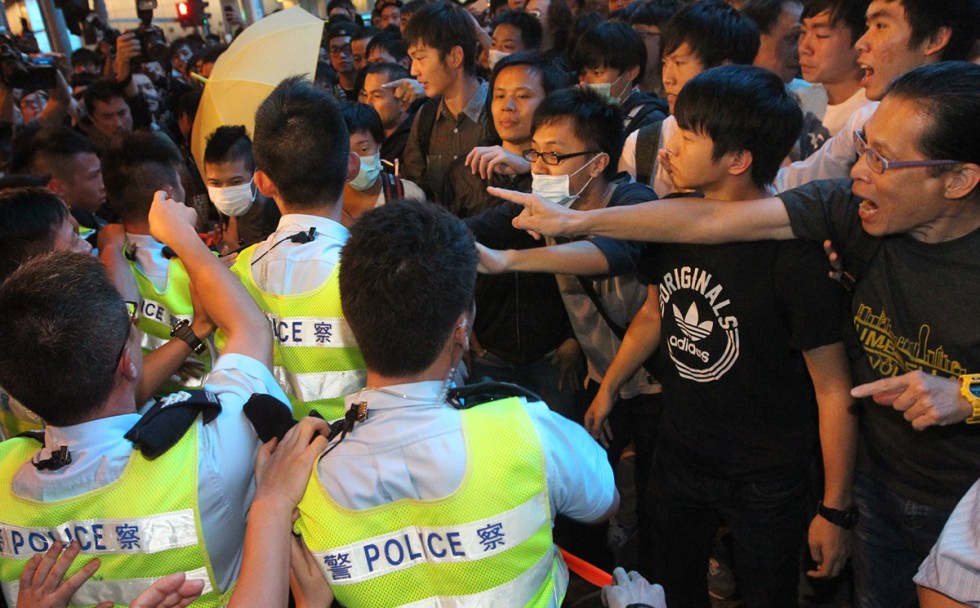
Police officers clash with pro-democracy protesters in Mong Kok. Photo: Edward Wong
A former senior Hong Kong police officer has described the government's handling of the Occupy Central protests as "damaging" to the city's future and to its judiciary.
Security risk consultant and former head of the police criminal intelligence unit, Steve Vickers, who maintains close links to many in the force, also criticised the protesters, saying it was time for them to get off the streets and find a way of ending what had become a "very dirty and messy" situation.
The government declined to respond to Vickers' comments. But lawmaker Tam Yiu-chung, of the pro-Beijing Democratic Alliance for the Betterment and Progress of Hong Kong, defended the government's approach, saying it had to act to end "unrealistic and illegal" actions by the students.
Last night, Mong Kok was calm after days of turmoil as bailiffs and then police enforced court injunctions to remove protesters from their encampment, which blocked some of the district's main thoroughfares, sparking violence and arrests.
In his latest security assessment of the situation, Vickers said the government must make a decisive political effort to end the impasse or risk undermining the judiciary and police by "hiding behind bailiffs". But Vickers, CEO of risk consultancy SVA, said: "This is a political situation which cannot be resolved by force. This quasi-judicial-police approach - whatever you want to call it - is not helpful to anyone. It is damaging to Hong Kong's future. It is damaging to the judiciary. It uses a large number of resources and is inefficient."
For Vickers, the government's current strategy risks cannibalising the police - whose hands he says are tied - and sullying the name of the judiciary.
The comments echo those of protest leaders and student activists, who regularly lambast Chief Executive Leung Chun-ying for failing to engage with the so-called umbrella movement.
Occupy Central co-founder Benny Tai Yiu-ting yesterday said the police cleared the Mong Kok protest zone with "legitimacy it stole from court" and expected the government to use the same methods to clear the sites in Admiralty and Causeway Bay.
But Tai warned that the clearance would not solve the ultimate problem, and that the occupation had already nurtured a generation ready to fight for democracy.
"Is it possible for the police to station such a large number of officers at every [formerly occupied] site … to prevent people from storming the roads again? Couldn't protesters occupy other roads instead?" he asked in a Facebook post.
Protester Nikki Lau, 34, has camped in Admiralty for the past two months. She said the chief executive needed to engage with the protesters. "Any rightful leader would come and address the situation - no matter whether they are pro or anti. But [Leung] has hidden behind everything."
Vickers' criticisms, however, were not reserved solely for those in power, with the former police officer also urging protesters to rethink their strategies. "It is just becoming more violent. It is becoming a very dirty and messy situation," Vickers said.
"With the bulk of people turning against them, it is time for the students to review their tactics."
DAB chairman Tam said the government should not yield to the Occupy protesters, who had been fighting using illegal means for something "unrealistic".
"The protesters have called on Beijing to scrap its decision on reform, which is definitely impossible. They should get back to reality," Tam said.
This article appeared in the South China Morning Post print edition as Strategy against protesters 'is damaging city'
Task force set to give young people more 'upward mobility' hope
Doubts raised over Leung's notion that lack of upward mobility fuels protests like Occupy
PUBLISHED : Sunday, 30 November, 2014, 5:15am
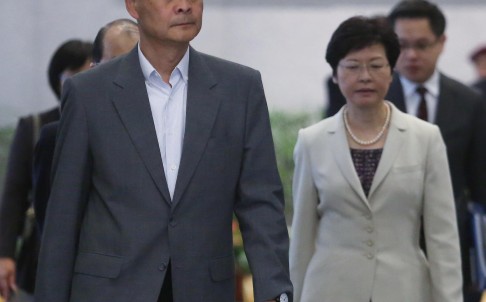
A new government task force has been set up to boost the chances of young Hongkongers to get ahead in life as Chief Executive Leung Chun-ying said a lack of "upward mobility" was one of the reasons large numbers of young people joined the Occupy protests.
 Convened under the Commission on Poverty - a flagship creation of the Leung administration - the task force will be responsible for coming up with strategies to alleviate the feeling of many young people that they could be Hong Kong's first generation to grow up less well off than their parents.
However, the decision raised the eyebrows of two commission members, and one of Leung's key allies said the protesters' concerns were mainly political.
The announcement came as the government pointed to a "marked improvement" in the poverty situation last year, as the latest estimate of the number of poor people - 970,000 - was the first time it had fallen below a million since 2009.
The poverty rate also sat at an all-time low, at 14.5 per cent. The government said this was thanks to cash handouts and other welfare spending.
Speaking at government headquarters, a wall away from the Admiralty sit-in zone, Leung said: "One of the reasons [for Occupy] - I am not saying it is a major reason or minor reason; obviously the main cause is the disagreement on constitutional development - is a lack of upward mobility."
Executive Council member Fanny Law Fan Chiu-fun said the student leaders had "no such problem as upward mobility".
Instead, she said, protesters were pursuing "universal values". She said the task force's scope of work should be clarified, and more teenagers invited to join.
Chua Hoi-wai, chief executive of the Council of Social Service and a committee member, said Occupy was never cited as a reason for the task force during discussions in July, when the civil-disobedience movement was not yet a reality. "I'm not sure if there was any misunderstanding, or [Leung] was careless," Chua said, noting that Occupy was joined by teenagers of every wealth level.
Another member, pan-democratic lawmaker Frederick Fung Kin-kee, said Leung was "hugely mistaken". Leung later hit back at Fung for leaving the meeting early.
Leung told international media last month that the nomination process for chief executive contenders could not be about numeric representation, or "you'd be talking about half of the people in Hong Kong who earn less than US$1,800 a month".
Chief Secretary Carrie Lam Cheng Yuet-ngor, chairwoman of the commission, said the people of Hong Kong "will all want to have more participation in our political system".
Lam said future room for the poverty rate to drop would be "limited", and drew attention to households that had at least one member at work, did not claim welfare but remained poor.

This article appeared in the South China Morning Post print edition as Task force aims to give youth more hope
Student leaders seek to 'send message' to move occupiers off streets
PUBLISHED : Sunday, 30 November, 2014, 5:16am
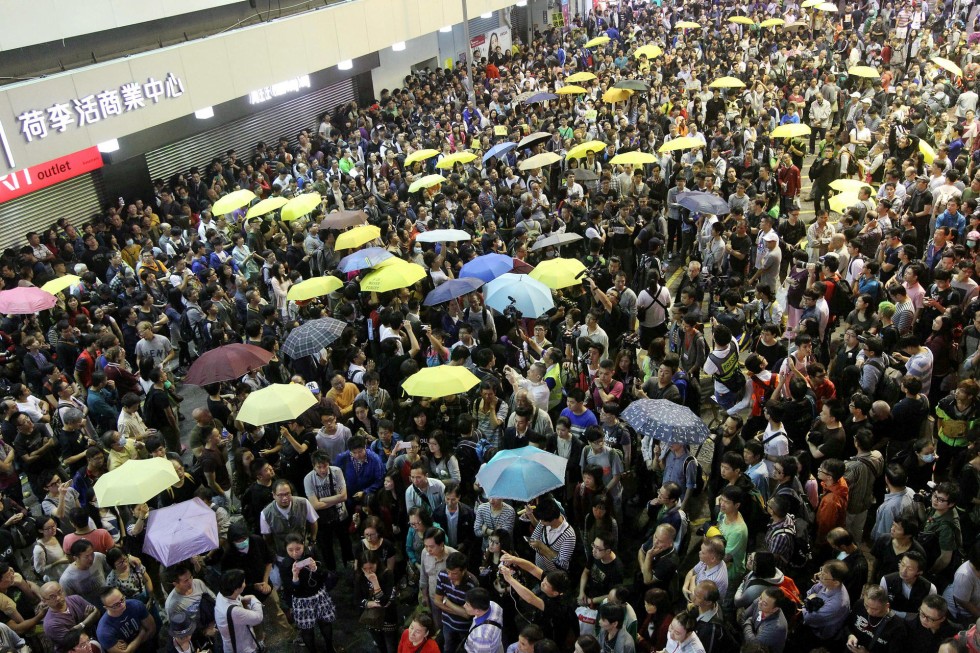
Protesters gather in Mong Kok yesterday as some call for a different strategy. Photo: Edward Wong
Student leaders of the Occupy Central movement were last night plotting a possible strategy to get the dwindling hard core of protesters off the streets while retaining credibility by appearing not to have given up without a fight.
A well-placed source close to the Federation of Students said their call for people to come prepared for escalated action - possibly by blocking the entrances and exits to government headquarters - would force the police to make arrests, sending the signal to those less radical diehards still encamped in Admiralty that it was time to leave.
The strategy - which has not been finalised - flies in the face of the approach preferred by the core trio of older Occupy Central founders led by Benny Tai Yiu-ting, who plan simply to hand themselves in to the police in a bid to convince an increasingly sceptical public that they don't want to flout the rule of law.
The founding trio of Occupy, Tai, Chan Kin-man and the Reverend Chu Yiu-ming, are set to surrender to police on Friday after ditching a plan to do it today because "they want to stay until the end of the fight", according to a source close to that camp.
"The three co-founders once considered surrendering earlier than their scheduled date - December 5 - to avoid a confrontation, but in the end they scrapped the idea as others want them to stay until the end of the fight," the source said.
The student leaders, however, hope that being arrested amid a police crackdown on escalated action would prompt protesters to rethink how the movement should proceed.
"It is a common belief of organisers that it is time to get off the streets and take the campaign for democracy forward to a more sustainable format," said a source close to the inner core of the Federation of Students. "Surrounding government offices would prompt police to take action, and it is hoped that the protesters will start thinking about how to carry on the movement elsewhere, without occupying."
Federation of Students secretary general Alex Chow Yong-kang had earlier called on protesters to get back to Admiralty today with their "safety equipment" such as umbrellas and goggles. "It could be another turning point" for the movement, he said on Friday, without disclosing any concrete details.
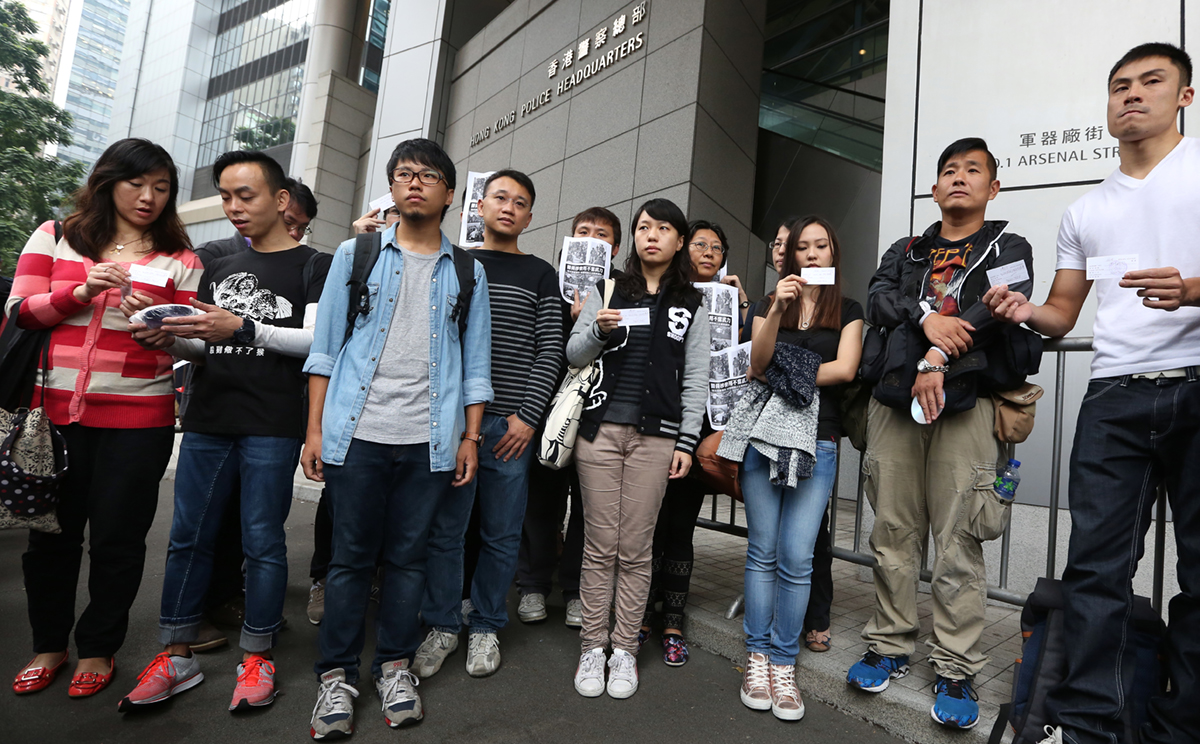
Meanwhile, a group of journalists and members of the public filed reports at the police headquarters en masse yesterday regarding officers' recent alleged assaults on journalists.
The move by the members of five local journalists' groups came after a NOW TV engineer and an Apple Daily videographer were arrested while covering events at the Mong Kok protest site over the past week.
Other groups that also reported to the police collectively included the Hong Kong Journalists Association, the RTHK Programme Staff Union, Next Media Trade Union and Journalism Educators for Press Freedom.
This article appeared in the South China Morning Post print edition as Student leaders plan to press occupiers off streets
Occupy supporters and police clash as Hong Kong protests escalate
Riot police use pepper spray and batons to stop hundreds of pro-democracy activists from storming the government’s headquarters
PUBLISHED : Sunday, 30 November, 2014, 5:16am
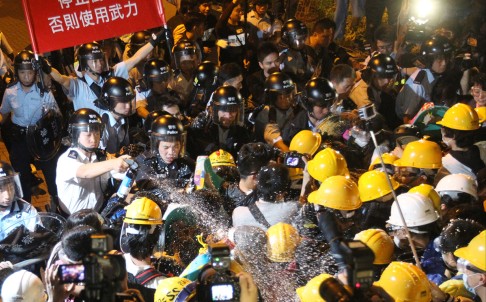
Students fought running battles with police outside government headquarters on Sunday night as Occupy protesters tried to storm the Admiralty compound and lay siege to Chief Executive Leung Chun-ying's office.
Minutes after student leaders called on the thousands gathered at the Admiralty Occupy encampment, hundreds of protesters - wearing an assortment of hard hats and protective masks - thronged around government headquarters and Tamar Park and began trying to breach police lines at various points.
Police used pepper spray and baton charges to repel them, leaving some bloodied and requiring treatment by makeshift medics. Key areas of violence were Lung Wo Road and the walkways from Harcourt Road to government headquarters.
Watch: Occupy protesters clash with police in Admiralty as movement escalates
At the same time, fresh trouble flared in Mong Kok as police and protesters clashed, although the disturbances subsided after 10 or so minutes, leaving the situation tense.
The renewed violence came after police had earlier warned of resolute action to prevent any such blockade, while Federation of Students leaders told activists to avoid “giving the police a legitimate reason to take violent actions” as they stepped up the protests.
In a statement at 10.20pm, police “strongly condemned” the “unlawful assemblies in Admiralty for storming police cordon lines and obstructing roads”.
Vowing to use “suitable force resolutely”, they urged protesters to “stay away from radicals and troublemakers”.
Police issued a second statement an hour later urging organisers of Occupy to end their “illegal” actions.
A spokesman said the violent charging of police cordons had deviated from the movement’s non-violent principle as claimed by the organisers.

The Heads of Universities Committee last night to remain calm and be rational. “Please do not take part in any attack against the government headquarters,” it said in a statement. “Stay away from areas where there are clashes. Evacuate from the site immediately if your personal safety is in danger. Please contact your respective institution for help if needed.”
The escalation, rumoured for much of the weekend, was announced at 9pm on the main stage, when federation representative Nathan Law Kwun-chung urged people to head towards the government offices.
He said there would be a “long journey” through the night, and called on Hongkongers to “walk” with them.
Soon afterwards, supporters began streaming towards the government offices on Tim Mei Avenue. Soon after, police in riot gear raised warning signs in Tamar Park telling protesters to “stop charging”.
Hours earlier, police warned the public against attending a rally called by the federation in the protest zone.
 About 3,000 officers were posted in Admiralty, with a further 4,000 in Mong Kok, where protests have continued despite the clearance of the main protest zone last week.
Describing the rally as posing an “extremely high risk”, Senior Superintendent Kong Man-keung of the police’s public relations branch warned the public against attending. He said student leaders had urged people to bring supplies to the site.
“I emphasise that if anyone obstructs the police in execution of their duty, charge the police line violently, or attempt to block the central government office, police will take resolute enforcement actions,” Kong said.
Oscar Lai Man-Lok, spokesman for student group Scholarism, said the crowd was the biggest in at least two weeks. He told protesters to stick to their non-violent principles and not to provoke or charge at police.
Among those present, there was support for the idea of stepping up the campaign.
Hin Kan, a university student, said he felt the night's action was "encouraging". "Unlike the guerrilla warfare in Mong Kok, we have here demonstrated a clear goal of blockading the government headquarters by storming the different access routes. This is a clear action demanding the government to respond to our call for universal suffrage."
"Maybe we will lose tonight, but the call for democracy had taken root in our hearts."
“The government has not responded to our demands yet, so we have to do something,” said Gary Wu, 24, an advertising worker.
“I support their plan to escalate their action ... But if it is to stop all civil servants from going to work, it will affect people’s livelihoods and I have reservations,” said another protester.
Kevin Suen, also a university student, said: “How ironic. Christmas lights are shining but here we stand fighting for universal suffrage.”
He said he was not afraid of the police. “Two months on, I’ve got used to the pattern. we advance, police use pepper spray or batons and we step back. Those behind then forward.”
Schoolgirl Fish Chan, 16, said she had attended despite being urged to stay away by her mother, who feared she would be hurt.
Earlier, a group of secondary school pupils staged a barefoot walk around the government headquarters. They knelt down after every 28 steps and walked around the buildings nine times to remember the police’s use of tear gas on September 28.

A former student leader exiled from the mainland after the bloody Tiananmen Square crackdown told RTHK today that he feared there would be bloodshed at the Admiralty rally.
In the event of violence, he said he would push for Hong Kong’s Chief Executive Leung to face an international court.
Speaking in Taipei in his capacity as chairman of New School for Democracy, he said the school and other human rights groups would consider attempting to get Leung tried at the Hague International Court of Justice for crimes against humanity.
"The violence the Hong Kong government used has already exceeded a standard acceptable in humanity," he said.
Wang has been exiled since the 1989 Tiananmen democracy movement ended in a bloody military crackdown.
A well-placed source close to the Federation of Students said their call for people to come prepared for escalated action - possibly by blocking the entrances and exits to government headquarters - would force the police to make arrests, sending the signal to those less radical diehards still encamped in Admiralty that it was time to leave.
The strategy - which has not been finalised - flies in the face of the approach preferred by the core trio of older Occupy Central founders led by Benny Tai Yiu-ting, who plan simply to hand themselves in to the police in a bid to convince an increasingly sceptical public that they don't want to flout the rule of law.
The founding trio of Occupy - Tai, Chan Kin-man and the Reverend Chu Yiu-ming - are set to surrender to police on Friday after ditching a plan to do it today because "they want to stay until the end of the fight", according to a source close to that camp.
"The three co-founders once considered surrendering earlier than their scheduled date - December 5 - to avoid a confrontation, but in the end they scrapped the idea as others want them to stay until the end of the fight," the source said.

The student leaders, however, hope that being arrested amid a police crackdown on escalated action would prompt protesters to rethink how the movement should proceed.
"It is a common belief of organisers that it is time to get off the streets and take the campaign for democracy forward to a more sustainable format," said a source close to the inner core of the Federation of Students.
"Surrounding government offices would prompt police to take action, and it is hoped that the protesters will start thinking about how to carry on the movement elsewhere, without occupying."
Federation of Students secretary general Alex Chow Yong-kang had earlier called on protesters to get back to Admiralty today with their "safety equipment" such as umbrellas and goggles. "It could be another turning point" for the movement, he said on Friday, without disclosing any concrete details.
Meanwhile, a group of journalists and members of the public filed reports at the police headquarters en masse yesterday regarding officers' recent alleged assaults on journalists.
The move by the members of five local journalists' groups came after a NOW TV engineer and an Apple Daily videographer were arrested while covering events at the Mong Kok protest site over the past week.
Other groups that also reported to the police collectively included the Hong Kong Journalists Association, the RTHK Programme Staff Union, Next Media Trade Union and Journalism Educators for Press Freedom.
A group of British lawmakers investigating the UK’s relations with Hong Kong have been told China will not allow them into the former colony, Agence France-Presse reported.
The Foreign Affairs Committee, a panel of lawmakers who scrutinise the Foreign Office’s work, is looking into Britain’s relations with Hong Kong 30 years on from the 1984 Joint Declaration, which set out the terms of the 1997 handover of Hong Kong.
Richard Ottaway, who chairs the cross-party panel, said he would on Monday call for an emergency debate in parliament on the situation.
The 11-member committee, which reports to the lower House of Commons, planned to visit Hong Kong before the end of the year as part of its inquiry.
“The Chinese government have, in past weeks and months, registered their opposition to the inquiry,” the committee said in a statement.
“I have been informed by the Chinese embassy that if we attempt to travel to Hong Kong we will be refused entry,” Ottaway said.
“We are a committee of elected members of parliament from a democratic nation who wish to scrutinise British diplomatic work in Hong Kong.
“The Chinese government are acting in an overtly confrontational manner in refusing us access to do our job. “I shall be asking the speaker tomorrow to grant an emergency debate on the floor of the house,” he said.
Earlier this month, the panel questioned Chris Patten, the governor who oversaw the transfer of Hong Kong from British to Chinese sovereignty.
He rejected Beijing’s assertions that Hong Kong’s political situation was no longer anything to do with London, citing binding agreements signed between the countries. “The Joint Declaration provides obligations on China to us for 50 years,” he said.

This article appeared in the South China Morning Post print edition as Clashes as protest escalates in Admiralty
Police use hoses to drench Occupy protesters outside Hong Kong's government HQ

Good morning and welcome to scmp.com's live coverage of Hong Kong's pro-democracy protests. Overnight, students have gathered near Legco, the government headquarters, and are this morning involved in a tense standoff with police. Pepper spray and batons were used last night to keep protesters away from government buildings. Protesters are pushing Beijing for democratic reforms in the 2017 chief executive election. Students had gathered in Admiralty after a call from their leaders, vowing to escalate action shortly after the deadlocked protest entered its second month.


