2017年11月17日 星期五

35+ Different Ways to Say “You’re So Smart”


35+ Different Ways to Say “You’re So Smart” 

Instead of Saying “You're So Smart", You Should Say...


1. You have really improved on…
2. That must have been a hard choice to make. You have a lot of integrity.
3. What a creative solution to that problem!
4. You work very well with your classmates.
5. What a great friend you are!
6. Wow, that was brave. Your willingness to take a risk there really paid off.
7. You tried really hard on that.
8. You are one of the most reflective learners I know.
9. You never gave up, even when it was hard.
10. You have such a positive attitude.

11. I love how you took ownership of that!
12. That was a very responsible thing you did.
13. I like the way you are doing…
14. I admire the way you…
15. You should share that idea with Luke. He would really appreciate learning this from you.
16. You really handled that situation well because…
17. It was brave of you to…
18. I love that you are always prepared for class.
19. I wouldn’t have thought to use that approach. You really know how to think outside of the box.
20. You did a great job of helping…with her assignment.
21. You have taken great care of your desk/locker/book.
22. You remembered to bring…to class! Great job!
23. I know I can trust you because…
24. Your patience is a real gift. It will continue to serve you well as a learner.
25. I can tell you studied very hard!
26. I appreciate how helpful you were when you…
27. I remember how overwhelmed you seemed by... Tell me what you did to overcome the hurdles you faced. You’re inspiring me.
28. You did a great job of participating today!
29. I could tell you worked well with your group because…
30. I know you’ve been working hard to improve…., and this is where I see you succeeding.
31. It is so nice that you value other people’s opinions.
32. I can tell you tried your very best because…
33. You really encouraged your classmates today when you…
34. What a creative way to solve that problem!
35. You are not afraid of a challenge! I like that!
36. You thought of that all by yourself!
37. You remembered to… (Specific skill)! Great thinking!
38. I am so proud that you made that choice.


https://www.eslbuzz.com/35-different-ways-to-say-youre-so-smart/
Flag Counter


2017年11月16日 星期四

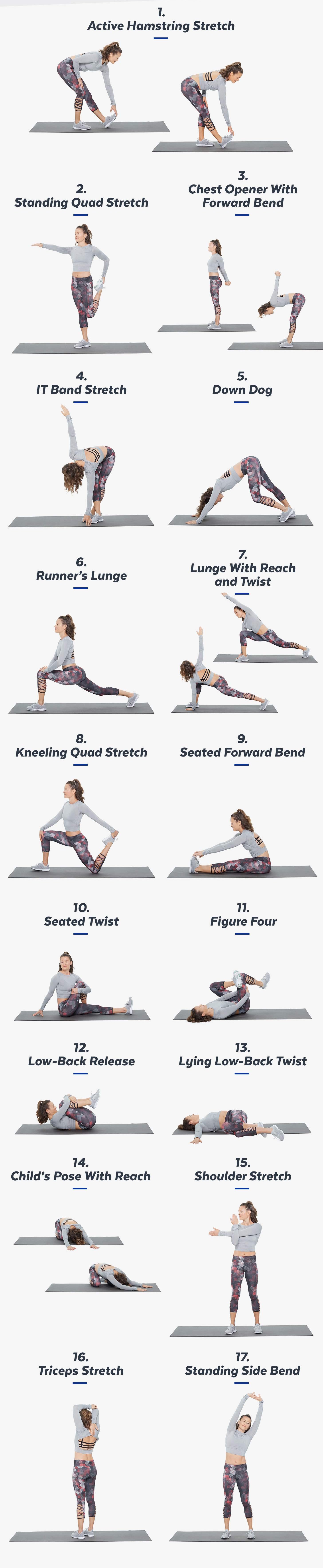
全身拉筋指南


全身拉筋指南


拉筋(靜態伸展)當然有益健康,但何時是拉筋最佳時刻?

A. 睡醒時
B. 運動前
C. 運動後
D. 睡覺前

如你不確定,請進來看看吧!另外送上一張教你全身拉筋的圖片,Save進你的手機吧!


答案:C,運動後拉筋是最好的時刻,D 睡覺前亦是不錯的選擇。但請盡量避免在剛睡醒時或在運動前進行靜態伸展,因為那時候的肌肉比較冷及僵硬,情況就如你去拉扯一條已經變硬的橡筋一樣,很容易受損。

如果你真的想在早上拉筋,不妨先冲一毎熱水浴,使肌肉暖起來。另外,運動前較適合進行動態伸展,亦關節及肌肉熱身,減低因運動而受傷的風險。

拉筋指引
每個動作拉3-6組,每組20-30秒,並休息15-20秒
不要有疼痛感,適量的拉扯感已足夠
這是靜態伸展,因此避免在伸展時前後移動
如在入睡前進行這伸展動作,可加快身體復元速度,及改善睡眠質素


伸延閱讀


http://hk.running.biji.co/index.php?q=news&act=info&id=1737&subtitle=%E5%85%A8%E8%BA%AB%E6%8B%89%E7%AD%8B%E6%8C%87%E5%8D%97
Flag Counter


How to Accept and Refuse Invitations in English


COMMON EXPRESSIONS

How to Accept and Refuse Invitations in English 

Making, accepting or refusing an invitation is always tricky: finding the right words in English to do so with tact is essential.

Formal Situation

Invitations:
  • Would you like to…
  • I’d very much like you to…
  • We should be pleased/delighted if you could…
  • Would you care to …
  • You will … won’t you?
Accepting:
  • That’s very kind of you
  • We’d very much like to…
  • What a delightful idea.
  • With the greatest pleasure.
  • Thank you very much for inviting me.
Refusing:
  • I’m very sorry, I don’t think I can.
  • I’d like to, but…
  • I’m afraid I’ve already promise …
  • Thank you for asking me, but …
  • Unfortunately I can’t …

Informal Situation

Invitations:
  • Why don’t you come to …
  • Like to come to …
  • Shall we come to …
  • You must come to …
  • How about tomorrow morning?
  • Let’s meet at … o’clock.
Accepting:
  • I would/will ...
  • That would be nice.
  • I’d like to love to come.
  • All right (then).
  • I’ll come I promise.
  • I’ll be there.
Refusing:
  • Sorry, I can’t.
  • I’d love to, but …
  • I don’t think I can.
  • I wish I can, but …
  • Sorry, I don’t think I can make it.
  • I’m so sorry I can’t make it.

Examples: Making, Accepting & Declining an invitation in English

Invitations:
  1. Will you join me for coffee?
  2. I’m going out for a bite to eat. Would you like to join me?
  3. Could we have lunch together one day?
  4. Would you like to come to the cinema with me tonight?
  5. We’re all going to watch the parade later on. Care to join us?
  6. We’re having a party next weekend. Would you like to come?
  7. How about coming to the barbecue at the tennis club?
  8. I’ve got two tickets for a concert on Friday. Would you like to come?
Accepting:
  1. I’d love to. Thanks
  2. I’d be happy to. Thanks
  3. With pleasure.
  4. Sure, I’d love to.
  5. Sure! Good idea!
  6. I’d love to. Thanks.
  7. Sure! That should be fun!
  8. Super! I’d love to.
Refusing:
  1. Sorry. I’m afraid I don’t have time.
  2. Sorry. I’m meeting a friend for lunch.
  3. I’d love to but I’m very busy at the moment.
  4. Sorry, I can’t. I’ve got other plans.
  5. Nice of you to ask me but I’ve got an appointment.
  6. What a pity. I’m away next weekend.
  7. Sounds great but I’m afraid I’m not free.
  8. I’m tied up on Friday. Sorry.


https://www.eslbuzz.com/how-to-accept-and-refuse-invitations-in-english/
Flag Counter


Grammar: Differences between Can and Could


Grammar: Differences between Can and Could 

Can or could? Both can and could are modal auxiliary verbs...


In some cases, ‘could’ functions as the past tense of ‘can’, but there are some important usage differences between the two.

The modal verb 'can' expresses possibility in either a dynamic, deontic or epistemic sense, that is, in terms of innate ability, permissibility, or possible circumstance. 
For example:
  • can speak English.
  • You can smoke here.
  • There can be strong rivalry between siblings.
The preterite form 'could' is used as the past tense or conditional form of can in the above meanings. It is also used to express possible circumstance: We could be in trouble here. It is preferable to use 'could' rather than 'can' when expressing possible circumstance in a particular situation (as opposed to the general case, as in the "rivalry" example above, where 'can' is used).
Both 'can' and 'could' can be used to make requests: 
For example:
  • Can/could you pass me the cheese? means "Please pass me the cheese" (where could indicates greater politeness).
It is common to use 'can' with verbs of perception such as see, hear, etc., as in can see a tree. Aspectual distinctions can be made, such as I could see it (ongoing state) vs. I saw it (event).
The use of 'could'  with the perfect infinitive expresses past ability or possibility, either in some  counterfactual circumstance (could have told him if I had seen him), or in some real circumstance where the act in question was not in fact realized: I could have told him yesterday (but in fact I didn't). The use of 'can' with the perfect infinitive, 'can have'..., is a rarer alternative to may have...
The negation of 'can' is the single word 'cannot', only occasionally written separately as 'can not'.
Though 'cannot' is preferred (as 'can not'  is potentially ambiguous), its irregularity (all other uncontracted verbal negations use at least two words) sometimes causes those unfamiliar with the nuances of English spelling to use the separated form. Its contracted form is 'can't' (pronounced /kɑːnt/ in RP and some other dialects). The negation of 'could' is the regular 'could not', contracted to 'couldn't'.
The negative forms reverse the meaning of the modal (to express inability, impermissibility or impossibliity). This differs from the case with 'may' or 'might' used to express possibility:  it can't be true has a different meaning than  it may not be true. Thus 'can't'  (or 'cannot') is often used to express disbelief in the possibility of something, as must expresses belief in the certainty of something. When the circumstance in question refers to the past, the form with the perfect infinitive is used: 
  • He can't (cannot)have doneit means "I believe it impossible that he did it" (compare he must have done it).
Occasionally  'not'  is applied to the infinitive rather than to the modal (stress would then be applied to make the meaning clear):
  • could not do that, but I'm going to do it anyway.


Source:
https://www.eslbuzz.com/grammar-the-difference-between-can-and-could/

Flag Counter